

August 19, 2026
Persian Heriz Rugs: History, Designs, Karajeh & Serapi Explained
Heriz rugs are northwest Persian village carpets with bold geometric medallions, rich color, and a sturdy wool pile. Here is how they relate to Karajeh, Serapi, and the wider Heriz district.
Heriz rugs are hand-knotted Persian carpets associated with the town of Heris, usually spelled Heriz in the rug trade, and with the villages around it in East Azerbaijan in northwestern Iran. The district sits northeast of Tabriz, one of Iran’s historic carpet and trading cities.
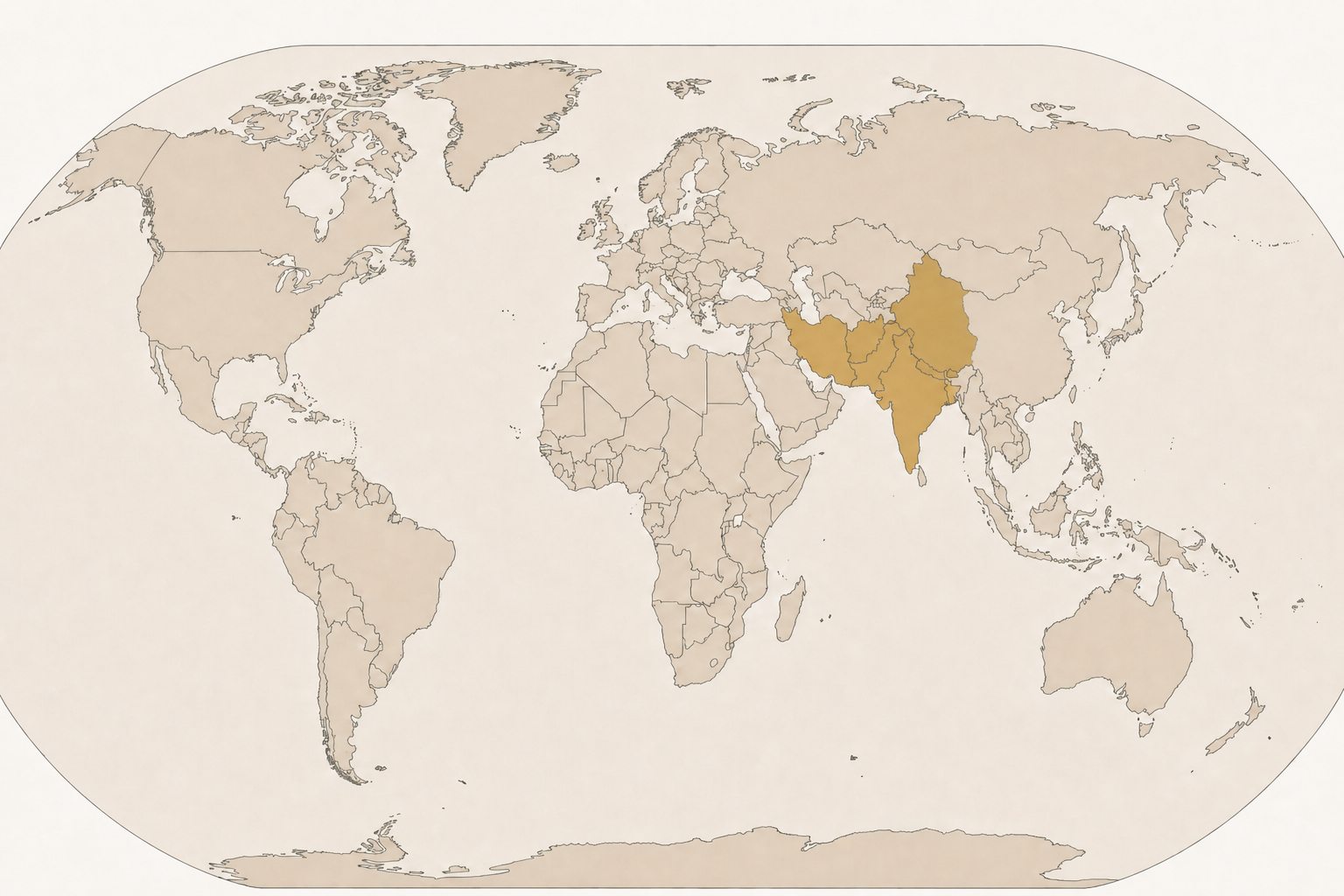
Heriz is not one exact pattern. It is a regional weaving tradition. Several nearby places developed their own handwriting while sharing a family resemblance: strong geometric drawing, wool pile, bold color, angular floral motifs, large medallions, and substantial village construction. That wider family includes work associated with Heriz, Karajeh, Bakshaish, Gorevan, and other communities nearby. Those rugs are related. They are not identical.
Historic weaving is Iranian. Later workshops in India, Pakistan, and Afghanistan also copy the Heriz medallion look. We mark origin on the map and on the tag.
Where Heriz rugs come from
Heriz lies in East Azerbaijan in northwestern Iran, in mountain country relatively close to Tabriz and the Caucasus. This is Iranian Azerbaijan, not the modern independent Republic of Azerbaijan.
Northwest Iran sat at a crossroads of Persian, Azerbaijani, Caucasian, and other regional artistic influences. That geography helps explain why a Heriz often looks different from the finely curved floral carpets of cities such as Kashan or Isfahan. Heriz patterns are usually more angular, more geometric, and more strongly outlined.
They are still Persian rugs from northwestern Iran. They are not Caucasian rugs. Neighboring textile traditions likely helped shape the visual language. The looms, the wool, and the carpets themselves belong to Iran.
History of Heriz weaving
Carpet weaving has deep roots in northwestern Iran. We do not have a single founding year for the look people now call a Heriz. What we can talk about with confidence is the period well represented by surviving carpets.
Heriz and related carpets became especially important in the nineteenth and early twentieth centuries, when Persian rugs were exported in large numbers to Europe and the United States. Room-size Heriz carpets did particularly well as decorative floors for American houses.
Weaving in the district was largely village production, not the highly organized urban workshops of major Persian cities. Designs often feel more direct and geometric than the extremely fine, curvilinear drawing of certain city carpets. That is not primitive work. It is a different tradition with its own priorities: scale you can read from a doorway, color that holds a room, and construction built for floors that get used.
The classic Heriz look
If you already know the type, this is probably what you picture: a large central medallion, strong corners, a richly colored field, angular vines, stylized flowers, serrated leaves, palmettes, and a substantial border.
The floral motifs are often turned into straight lines, hooks, points, diamonds, and other angular shapes. A flower that might look soft and curved on a fine city rug becomes bold and geometric on a Heriz. Persian floral ideas drawn with village geometry is one of the defining visual facts of the tradition.
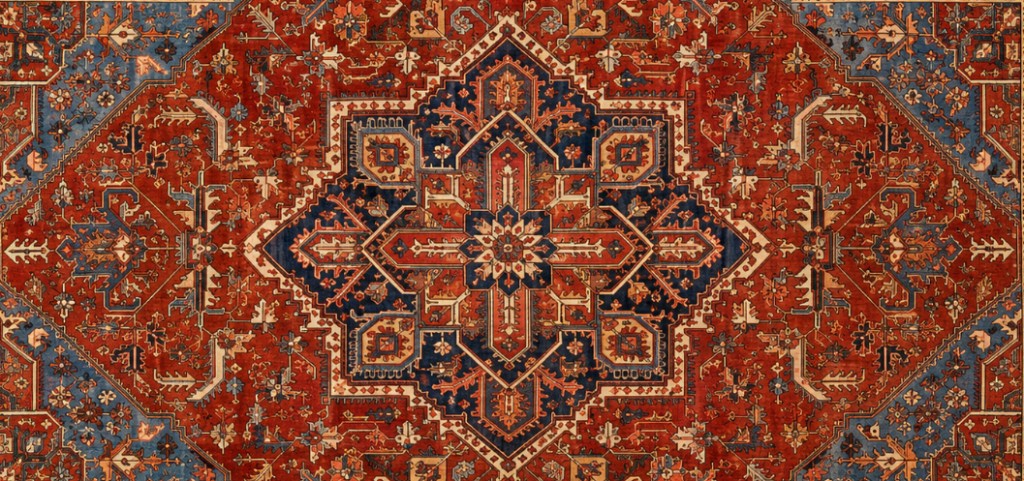
The cover on this page is that drawing up close: a layered, star-like medallion, rust-red field, navy, cream, and light blue, with flowers that have been given sharp corners.
The famous Heriz medallion
Many Heriz carpets put a large medallion in the middle of the floor. It can occupy a real share of the rug. You may see multiple layers, pointed extensions, a diamond-like center, strong outlines, large pendants, angular lobes, and contrasting color. The corners often repeat or answer the center.
That layout gives the carpet an architectural structure. From across a room the design is easy to read. It does not disappear into thousands of tiny details. There is a clear center, strong movement, and bold visual weight.
Not every Heriz has a central medallion. All-over designs exist too.
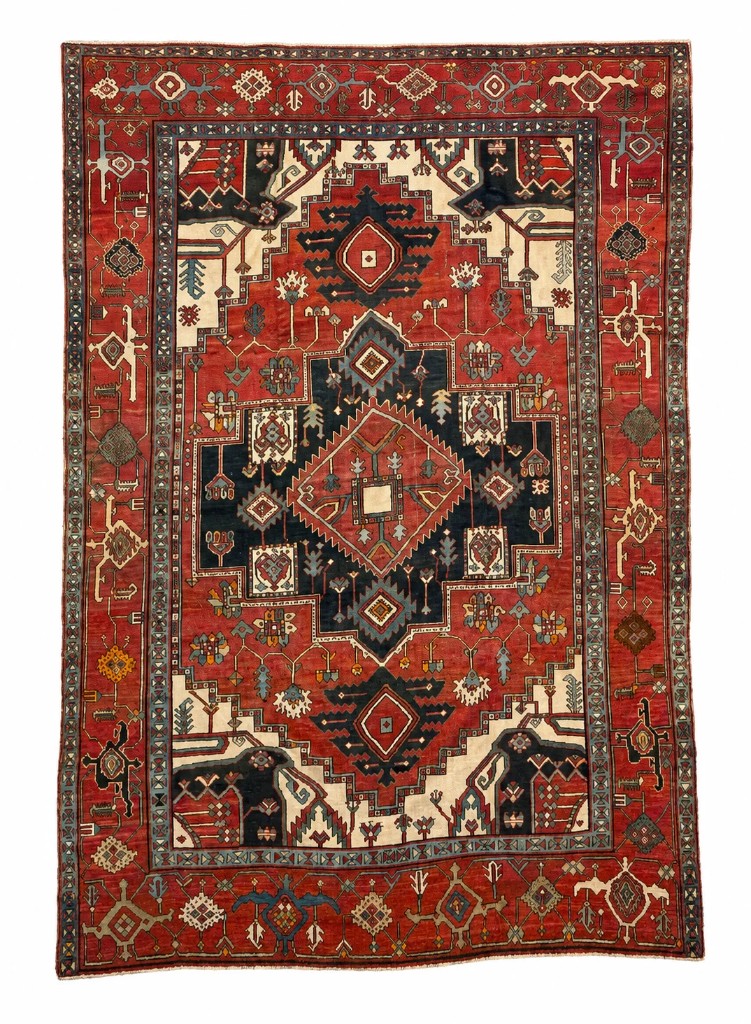
This one is in the Atlanta showroom. T-3945 is an antique Heriz, 11' x 14'10". It is the classic room-size plan: a large angular navy medallion on a rust-red field, ivory corners, and a navy border with palmettes you can read from across the floor. The listing also uses Serapi, the trade name for certain especially desirable antiques from the Heriz district. See it on the floor, or ask us to pull it when you visit.
All-over Heriz designs
The medallion format is the most recognizable. Weavers in the district also made carpets with repeating palmettes, leaves, flowerheads, angular vines, and geometric floral motifs across the field.
Those rugs can still have the same bold, rectilinear character even without a single commanding center. Identification should not rest on one motif alone.
Traditional Heriz colors
Antique Heriz rugs are especially associated with strong, saturated color: brick red, madder red, rust, terracotta, deep red, navy, indigo-like blue, medium Persian blue, ivory, cream, green, gold, mustard, coral, and soft salmon accents.
Many classic examples use a warm red or rust field with a dark blue or navy border. That is a familiar look. It is not a rule. Some Heriz carpets have blue fields, larger ivory areas, softer reds, or less usual palettes. Color alone does not prove a rug is a Heriz.
Older handmade rugs can also show abrash: natural shifts in the shade of wool from one area to another. That happens when yarn was dyed in different batches by hand. Abrash is a normal, often attractive part of a handmade carpet. It is not automatically damage.
How Heriz rugs are made
Traditional Heriz carpets are hand-knotted pile rugs. A common antique construction is wool pile on a cotton warp and cotton weft. The pile is the wool surface you see and walk on. The warp and weft are the structural grid underneath that holds the knots.
Heriz rugs are commonly associated with the symmetrical knot, sometimes called the Turkish or Gördes knot. Most customers do not need to memorize knot names. What matters is that the rug was tied knot by knot by hand, then sheared.
Not every Heriz ever woven is built exactly the same way. Regional and historical variation exists.
Knot count is not the point
Heriz rugs are generally not famous for extremely high knot counts. Next to certain Isfahan, Nain, Qum, or Kashan city carpets, a Heriz can look comparatively coarse.
That does not make it an inferior rug. The large geometric pattern actually benefits from a heavier, more substantial weave. The strength of a Heriz is wool quality, color, design, scale, proportion, drawing, construction, and the age and condition of the individual piece. More knots do not automatically mean a better rug.
Why they have a reputation for durability
Heriz rugs have long been appreciated for substantial village construction, strong wool pile, and practical room-size formats. Many antique examples have survived generations of household use.
Well-made Heriz rugs earned that reputation from things you can actually see: substantial wool, strong foundations, practical weaving, dense hand-knotted construction, and the long survival of old pieces. We do not claim they are scientifically proven to be “the most durable Persian rugs.” A well-made Heriz can age beautifully when it is cared for. Condition still has to be judged one carpet at a time.
Why the designs are so geometric
Many Heriz motifs are floral Persian designs interpreted in a geometric village style. Flowers, leaves, palmettes, vines, and medallions get converted into strong angular forms. The result can look almost architectural.
Northwest Iran lies near the Caucasus, a region with a long tradition of bold geometric textile design. Nearby Tabriz was a major Persian commercial and artistic center. There is no single source for Heriz drawing. The style developed in a place where different weaving traditions met. The mix of Persian floral structure and bold northwest-Iranian geometry is what makes the type recognizable.
Karajeh Heriz rugs
You may hear Karajeh, Karaja, Karadja, Gharajeh, or Qarajeh. Those are different English spellings for the same general place name.
Karajeh rugs come from Qarajeh and its surrounding area in the wider Heriz / East Azerbaijan weaving region of northwest Iran. Dealers sometimes say “Karajeh Heriz” because Karajeh belongs to that broader family. They should not simply be described as ordinary Heriz carpets with a different name. They have their own recognizable characteristics.
How Karajeh rugs differ from classic Heriz
Classic Heriz carpets are especially famous for large room-size rugs dominated by one major geometric medallion. Karajeh rugs are often encountered in smaller formats, runners, and gallery sizes, and they are particularly recognizable for a sequence of geometric medallions.
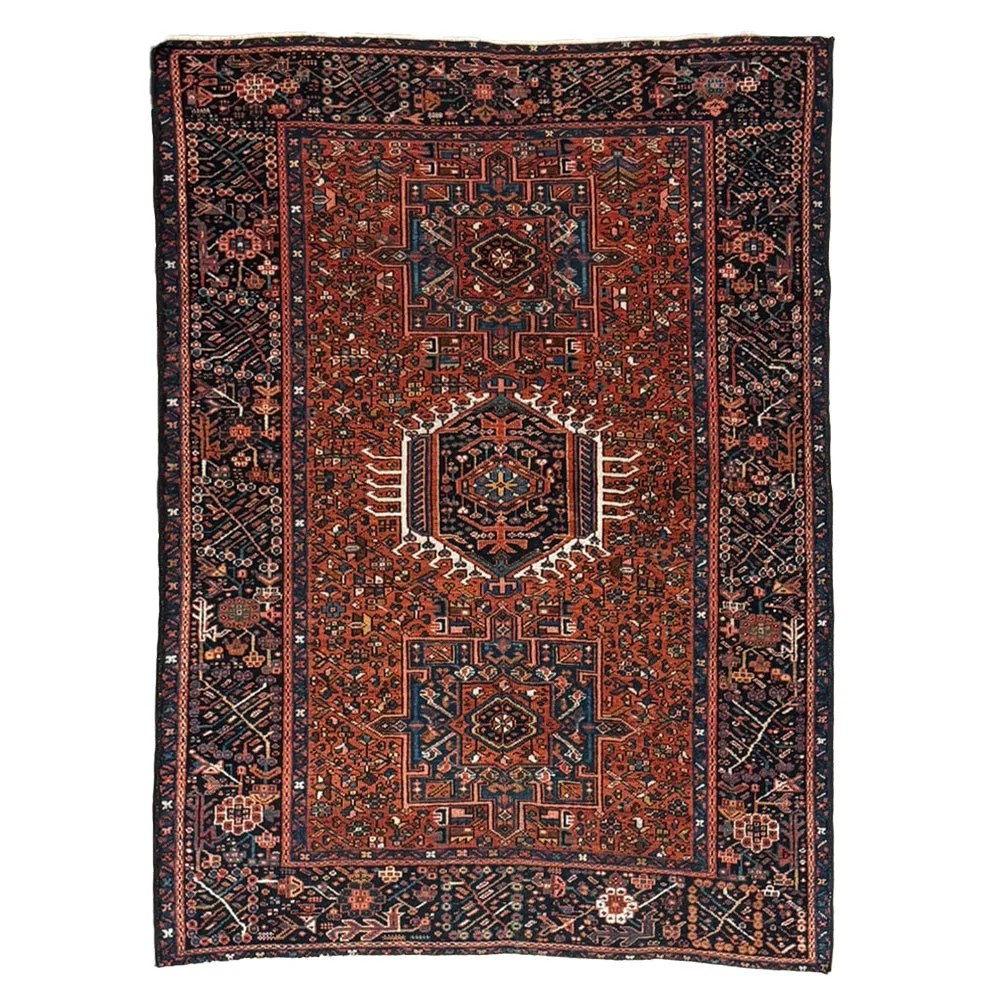
This one is in the showroom. T-1793 is an antique fine Karajeh Heriz, 4'10" x 6'6". Three geometric medallions run down a rust field: a larger navy hexagon in the center with an ivory sawtooth outline, and two related navy medallions above and below. That stacked rhythm is the Karajeh look, not one giant center commanding a 12-foot room. See it on the floor, or ask us to pull it when you visit.
A famous arrangement uses three medallions running down the center: eight-pointed stars, hooked medallions, octagons, diamonds, or other geometric forms. A common traditional layout puts a differently shaped or colored central medallion between two related star-like medallions. A Heriz may feel like one enormous geometric medallion commanding a room. A Karajeh often creates rhythm by stacking several smaller medallions along the length of the rug. Not every Karajeh uses exactly three medallions.
Karajeh rugs share the rich northwest Persian palette: deep navy, indigo, brick red, rust, coral, ivory, green, blue, gold, and brown. Dark blue fields are especially recognizable on many examples, often contrasted with strong red, ivory, green, or blue medallions. Navy is not a requirement. Many are wool pile on a cotton foundation. Construction still varies from piece to piece.
Is a Karajeh a Heriz?
Karajeh is best understood as a closely related weaving tradition within the broader Heriz-area and northwest Persian carpet family, not simply another name for a Heriz rug. That is why the trade sometimes uses “Karajeh Heriz,” especially when helping customers place the regional relationship.
Experienced dealers can often tell a classic Karajeh from a classic Heriz by size, structure, medallion arrangement, and drawing. In our inventory they sit together as a family, and Karajeh is also listed as its own type when you want to filter for it.
What is a Serapi rug?
Customers researching Heriz rugs often run into the word Serapi. It is closely associated with the Heriz district and with particularly desirable nineteenth-century carpets from the region. Serapi is not a separate Persian city or tribe.
The name developed as a rug-market designation. Antique carpets described as Serapi are generally associated with the Heriz weaving region, and they tend to be distinguished by more spacious drawing, large-scale medallions, strong but often more open compositions, attractive old color, and a finer or more refined execution than many later commercial Heriz rugs.
The exact use of the word varies in the trade. Every Heriz over 100 years old is not a Serapi. Serapi is not simply “the highest knot count of Heriz.” The distinction involves age, design, drawing, structure, color, and established trade usage, not one numerical test.
Heriz vs. Serapi
These are general tendencies, not foolproof rules. The individual carpet still has to be looked at.
Classic Heriz is often associated with bold geometric drawing, strong red and navy color, a large central medallion, dense surrounding ornament, substantial village construction, and many late-nineteenth and early-twentieth-century examples.
Antique Serapi is often associated with nineteenth-century Heriz-region production, more open spacing, large elegant geometric forms, strong medallion compositions, particularly desirable old colors, and a somewhat more spacious or refined visual effect.
Heriz vs. Karajeh vs. Serapi
Heriz is the broad regional tradition most famous for large room-size carpets with dramatic central medallions.
Karajeh is a related northwest Persian village tradition especially associated with smaller rugs, runners, and repeating geometric medallions.
Serapi is a rug-trade designation most often applied to especially desirable nineteenth-century carpets from the Heriz district with spacious, large-scale drawing.
These three labels do not represent three unrelated weaving cultures. They are connected through the carpet traditions of northwest Iran.
Other related Heriz-area rugs
The broader region also includes traditions associated with villages such as Bakshaish, Gorevan, Mehraban, Sarab, and others. “Heriz” exists inside a rich network of regional weaving rather than in isolation.
Dealers and collectors may use village names to describe differences in pattern, construction, size, color, fineness, and overall character. Those names are useful. They should not turn every northwest Persian geometric carpet into a separate universe.
Antique Heriz rugs
Many antique Heriz carpets encountered today date from the late nineteenth and early twentieth centuries. Customers like them because they combine age, hand craftsmanship, bold design, rich color, substantial construction, and decorative practicality.
Genuine antique examples can show wear, abrash, areas of lower pile, minor irregularities, old repairs, and small variations in shape. Those should be evaluated individually. Damage does not automatically make a rug desirable simply because it is old. Condition still matters. At the same time, normal age and patina can add a great deal to how an antique Heriz looks in a room.
New and vintage Heriz rugs
Heriz designs continued to be woven long after the antique period. Newer Persian or Heriz-inspired rugs may reproduce the classic central medallion, red field, navy border, and angular floral pattern.
A newly made rug is not automatically inferior. Customers should still know the difference between an antique Persian Heriz, a vintage Persian Heriz, a newly made Persian Heriz, and a Heriz-style rug woven somewhere else. Look at the listed age, origin, materials, and construction of the individual piece. Not every rug using a Heriz design was woven in Heriz.
Traditional Heriz heritage
Heriz rugs represent the carpet culture of northwestern Iran, where village weaving developed alongside commercial centers such as Tabriz and near the geometric textile traditions of the Caucasus. The recognizable result is traditional Persian flowers and medallions translated into strong geometric forms: village craftsmanship, wool, regional trade, and generations of community work. We do not claim that every antique rug can be traced to one named tribal family unless that is documented.
Why they work in interiors
Heriz rugs remain popular because their bold patterns are surprisingly easy to decorate with. Large designs can anchor a room without looking overly delicate or formal. They sit well in living rooms, dining rooms, libraries, offices, great rooms, bedrooms, and entries, next to leather, wood, stone, or antique furniture. They also work in contemporary rooms that need warmth.
The classic red-and-navy palette can add depth to a neutral room. A worn antique Heriz can look especially effective next to clean contemporary furniture, because the geometry gives the space contrast and history.
Unlike extremely delicate floral city rugs, Heriz designs often have enough scale to be appreciated from across the room. Closer inspection still shows small flowers, leaves, hooks, vines, and changes in color. That balance between big design and small handmade detail is a large part of the appeal. Karajeh and Serapi belong to the same northwest Persian story. Each has characteristics worth understanding. Not every geometric carpet from the region is exactly the same thing.
Browse Heriz rugs in our collection, see Karajeh rugs, or visit the showroom on Miami Circle in Atlanta.